

Sensors — Temperature
The Right Temperature Sensor for Every Application.
Temperature is one of the most commonly monitored variables in building performance — and one of the easiest to get wrong. Sensor type, installation environment, wire run length, and the surface or medium being measured all affect accuracy and reliability.
BluSENSE supports multiple temperature sensing technologies. Here's how to choose the right one for your application.
Talk to an Expert
Temperature Sensor Types
Three Technologies. One Right Answer for Your Application.
Sensor type, installation environment, wire run length, and the surface or medium being measured all affect accuracy and reliability. Here's what you need to know before you specify.

One-Wire Semiconductor Temperature Sensors
One-Wire sensors are our go-to recommendation for the vast majority of temperature monitoring applications — and for good reason. They combine low cost with excellent accuracy of ±0.2°C, and their communication architecture makes them uniquely practical for multi-point deployments. Each sensor has its own factory-programmed serial number stored on an onboard microchip alongside its calibration data. That unique ID means up to 10 sensors can be daisy-chained on a single wire — one input, multiple measurement points, minimal wiring complexity. Communication uses a simple single-wire serial protocol that BluSENSE hardware reads natively. Output is typically 3.3–5V serial communication. Unless your application has specific requirements that point elsewhere, the One-Wire sensor is the right choice.
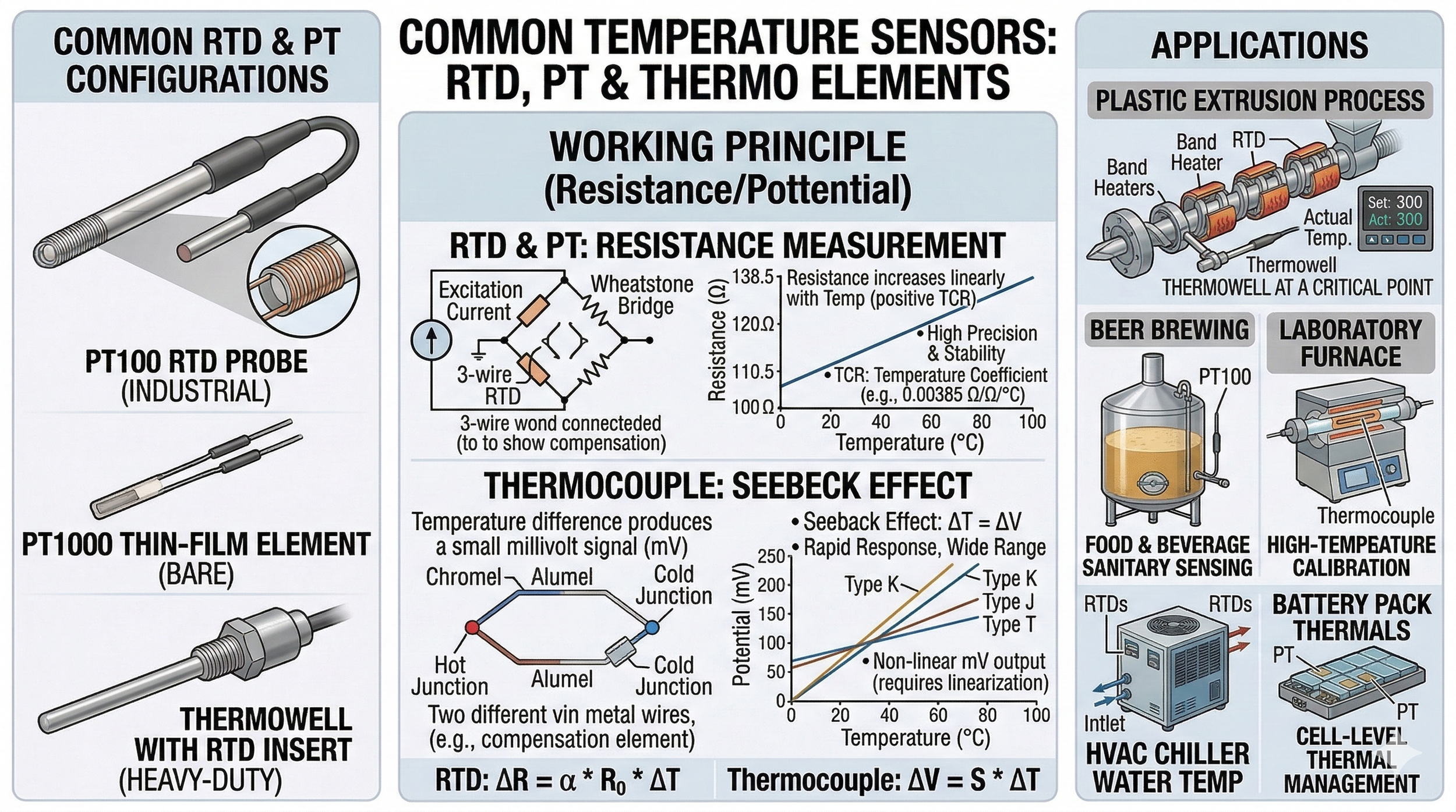
RTDs, PTs & Thermoelements
RTDs, PT sensors, and thermoelements all operate on the same principle — their electrical resistance changes in response to temperature. Accuracy is among the best available across any sensor technology, which makes them the right choice when precision is the top priority. The challenge lies in their output. Resistance changes translate to very small voltage signals — fractions of a volt — which makes accurate measurement more difficult, particularly over long wire runs or in electrically noisy environments such as mechanical rooms. In these conditions, signal interference can compromise the accuracy that makes these sensors valuable in the first place. Careful installation and shielded cabling are important considerations. Output is typically in millivolts or low volts.

Infrared Temperature Sensors — Contactless
Infrared temperature sensors measure the infrared light emitted by a surface to calculate its temperature — no physical contact required. Accuracy is excellent, and installation is straightforward: simply point the sensor's beam window at the surface or heat source you want to measure. There are interferences to be aware of — reflective surfaces, ambient IR sources, and the emissivity characteristics of the target material can all affect readings. Output is typically I2C or serial communication, compatible with BluNODE. IR sensors are available in two configurations: single-point sensors measure temperature at a focused spot — ideal for pipe surfaces, equipment housings, and targeted heat sources. Array sensors use a grid of typically 8×8 infrared elements to produce a crude 64-pixel thermal image or calculate an averaged temperature across a field of view — particularly useful where a single-point reading would be unreliable, such as measuring the surface temperature of aerated water where infused air bubbles create an uneven thermal surface.
Temperature Sensor Selection
Not Sure Which Temperature Sensor Is Right for Your Application?
Our support plans include expert guidance to match the right sensor to your specific system — covering accuracy requirements, installation environment, wire run distances, and BluSENSE compatibility.
The right sensor choice is the difference between reliable data and costly rework.