

Fixture-Level Behavioral Insight — and the Project That Inspired BluPULSE
When IAPMO needed event-level visibility into water use across 30 fixtures at their headquarters, off-the-shelf solutions couldn't deliver. BluSENSE deployed custom hardware that revealed occupant behavior patterns — and directly inspired the development of BluPULSE.
What This Project Demonstrated
A Leader in Plumbing Standards Wants Deeper Data
IAPMO is one of the most respected standards and codes organisations in the plumbing and mechanical industry. When their team wanted to go beyond meter-level consumption data and understand exactly how water was being used throughout their headquarters — fixture by fixture, event by event — they turned to BluSENSE.
The project would prove to be more than a monitoring study. The complexity and precision it required directly drove the development of early BluPULSE prototypes — hardware that has since evolved into the commercial BluPULSE product available today.
Meter-Level Data Wasn't Enough
Understanding occupant water use behavior in a commercial building requires a fundamentally different approach to monitoring. IAPMO needed to know which fixtures were being used, how often, and for how long — across 30 fixtures spanning bathrooms, break rooms, showers, a general laboratory, and a backflow prevention lab.
Off-the-shelf solutions couldn't deliver the granularity or reliability the project required. The deployment demanded custom hardware capable of capturing precise, event-level data from every point of use in real time — in a challenging installation environment.
Custom Hardware Built for the Complexity of the Site
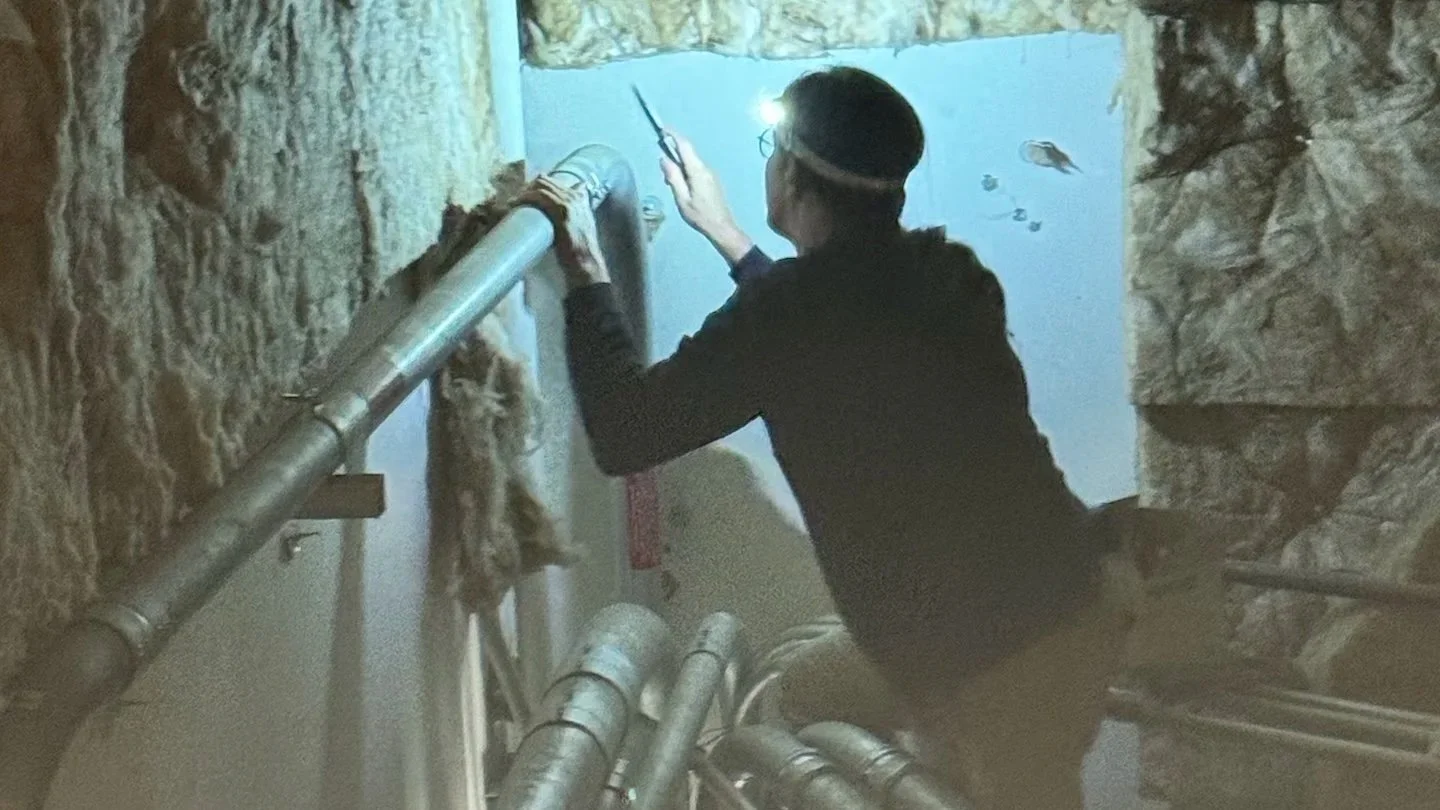
BluSENSE designed and deployed a custom fixture-level monitoring system tailored to the specific layout and requirements of the IAPMO headquarters. Flow sensors were installed on the supply lines of all 30 monitored fixtures, each connected to a dedicated end node with wireless data transmission capability.
The demands of the project — particularly the need for high-accuracy pulse counting across a large number of distributed fixtures — required BluSENSE to develop purpose-built hardware. These early prototypes formed the technical foundation for what would later become BluPULSE.
All data was stored securely on-site and delivered automatically via daily email as a complete CSV data load, giving the IAPMO facilities team continuous visibility without manual retrieval or cloud dependency.
Patterns Invisible at the Meter
The fixture-level data revealed patterns in occupant behavior that would have been impossible to detect at the meter — including variations in usage frequency, duration, and flow rate across different fixture types and locations throughout the building.
The monitoring also identified inconsistent flow rates and stream patterns across faucets throughout the facility. BluSENSE recommended replacing existing aerators with pressure-compensating models — a straightforward intervention with direct impact on both data quality and water efficiency.
Phase 1 Success — and a Product Born from the Field
The Phase 1 deployment demonstrated that fixture-level monitoring at this scale was not only feasible but highly effective at surfacing the behavioral data needed to inform water efficiency planning. The success of Phase 1 led to a proposal for a Phase 2 expansion — a system approximately four times larger, designed to extend monitoring to all 75 fixtures and appliances across the entire building.
The IAPMO project also left a lasting mark on the BluSENSE product line. The hardware challenges solved during this deployment directly shaped the development of BluPULSE, now available as a commercial product for fixture-level pulse monitoring across any building type.
The Hardware Behind the Study
BluSENSE Custom Data Acquisition System Early BluPULSE Prototype HardwareThe commercial BluPULSE product is the direct evolution of the hardware developed for this project — refined and productized for deployment across any building type.
Want Fixture-Level Visibility in Your Building?
BluPULSE brings the same event-level monitoring capability — refined from field experience — to any building with pulse-output meters or equipment. No monthly fees, no cloud dependency, no manual data retrieval.